

TL;DR:
- Forex coaching provides personalized guidance, feedback, and accountability to improve trading skills.
- Effective coaching can increase profitability and help traders develop disciplined, repeatable strategies.
- Selecting a reputable program with transparent results and ongoing support is crucial for success.
Fewer than 10% of retail forex traders achieve consistent long-term profitability. That number is uncomfortable, but it’s also clarifying. It means the market itself isn’t the main obstacle for most traders. Discipline, execution, and structured learning are. Forex coaching has emerged as a structured solution to exactly this problem, offering individualized feedback, accountability, and skill-building frameworks that self-directed study rarely provides. Whether you manage multiple funded accounts or copy trades to clients, understanding how coaching works and what it can realistically deliver could be the most important step you take this year.
Key Takeaways
| Point | Details |
|---|---|
| Coaching defined | Forex coaching means structured mentorship that provides feedback and accountability for better trading execution. |
| Impact varies | Results depend on the trader’s commitment, with most success coming from ongoing feedback, not just strategy copy. |
| No guaranteed profits | Even top coaching programs stress that market risk remains and consistency takes time and disciplined practice. |
| Choose carefully | Evaluate coaches based on proven student outcomes, transparency, and real-world support, not aggressive promises. |
What is forex coaching and why does it matter?
Forex coaching is a mentorship-based learning model where an experienced trader guides you through strategy development, risk management, and the psychological discipline required to trade consistently. It’s not a signal service. It’s not a copy-trading subscription. It’s a structured relationship designed to build your decision-making capacity over time.
For independent account managers handling multiple client accounts, coaching adds an accountability layer that solo practice rarely provides. For retail traders managing several personal or funded accounts, it fills the gap between knowing a strategy and actually executing it under pressure.
Typical coaching programs include several core components:
- Strategy education: Understanding setups, entry logic, and market structure
- Risk management training: Position sizing, drawdown limits, and reward-to-risk ratios
- Trade review sessions: Analyzing past trades to identify recurring mistakes
- Mindset work: Managing emotional responses to losses and winning streaks
- Technology setup guidance: Configuring platforms, indicators, and execution tools
Delivery formats vary widely. Some coaches offer private one-on-one calls, which allow highly personalized feedback. Others run group workshops where traders review setups together, which builds community and exposes you to different perspectives. Some programs include live trade reviews or recorded session libraries.
The real power of coaching is the feedback loop. Most traders repeat the same mistakes for months because they have no external observer to flag patterns. A coach sees what you can’t. That external perspective accelerates learning in ways that solo journaling or forum browsing simply cannot replicate.
The data supports this. Retail forex failure rates are broadly estimated at 70% to 95% — a range consistent with broker disclosure data required by regulators in major jurisdictions — but traders who apply structured feedback and maintain consistent reward-to-risk discipline report improvement in execution consistency. Individual results vary significantly based on market conditions, strategy quality, and the trader’s commitment to applying coaching principles. No specific return range can be guaranteed. Understanding the foundational forex trading terms is the starting point, but coaching is what turns that knowledge into consistent execution.

Trader checks results at kitchen breakfast bar
How forex coaching works: Models, methods, and what’s included
Not all coaching programs are built the same. The model you choose should match your current skill level, schedule, and trading goals.
High-touch private mentorship is the most intensive option. You get direct access to a coach for scheduled calls, trade reviews, and sometimes real-time feedback. These programs are expensive, often starting at $2,500 or more, but they offer the most customized experience. For account managers running client funds, this level of investment can pay off quickly if it improves execution and reduces drawdown.
Group coaching programs offer structured curriculum at a lower price point. You learn alongside other traders, review setups in shared sessions, and benefit from peer accountability. The tradeoff is less personalization.
Automated or signal-based coaching sits at the lower end. You receive trade alerts with explanations, but the feedback loop is weak. These programs are better suited to beginners building pattern recognition than experienced traders trying to refine execution.
Here’s a comparison of the main models:
| Model | Cost range | Personalization | Best for |
|---|---|---|---|
| Private mentorship | $2,500+ | High | Experienced traders, account managers |
| Group coaching | $500 to $1,500 | Medium | Intermediate traders |
| Signal-based programs | $100 to $500 | Low | Beginners, pattern learners |
A typical coaching onboarding process looks like this:
- Initial assessment: Coach reviews your trading history, risk tolerance, and goals
- Custom plan creation: A structured roadmap is built around your specific weaknesses
- Active coaching phase: Weekly or biweekly sessions with trade reviews and assignments
- Accountability check-ins: Progress tracking against defined benchmarks
- Graduation or continuation: Transition to self-directed trading or ongoing mentorship
For anyone serious about managing risk in forex across multiple accounts, steps two and three are where the real transformation happens. A coach who understands trade management strategy will push you to define rules before you enter a trade, not after.
Pro Tip: Before signing up for any program, ask for a sample session, a breakdown of what post-coaching support looks like, and verifiable student outcome data. Vague promises and aggressive upsells are warning signs.
Community feedback on programs like The Forex Trading Coach highlights a split picture. Some students report strong results and lasting skill development. Others note high costs and variable quality. The lesson is clear: the program matters, but so does your commitment to applying what you learn.
How coaching impacts trading outcomes: Evidence, stats, and real results
Let’s look at what the numbers actually say about coaching and performance.
Broker disclosure data consistently shows that the majority of retail trading accounts are not profitable in any given quarter. Long-term consistent profitability is achieved by a small minority of retail participants. These aren’t cherry-picked figures. They reflect the structural reality of retail forex trading.
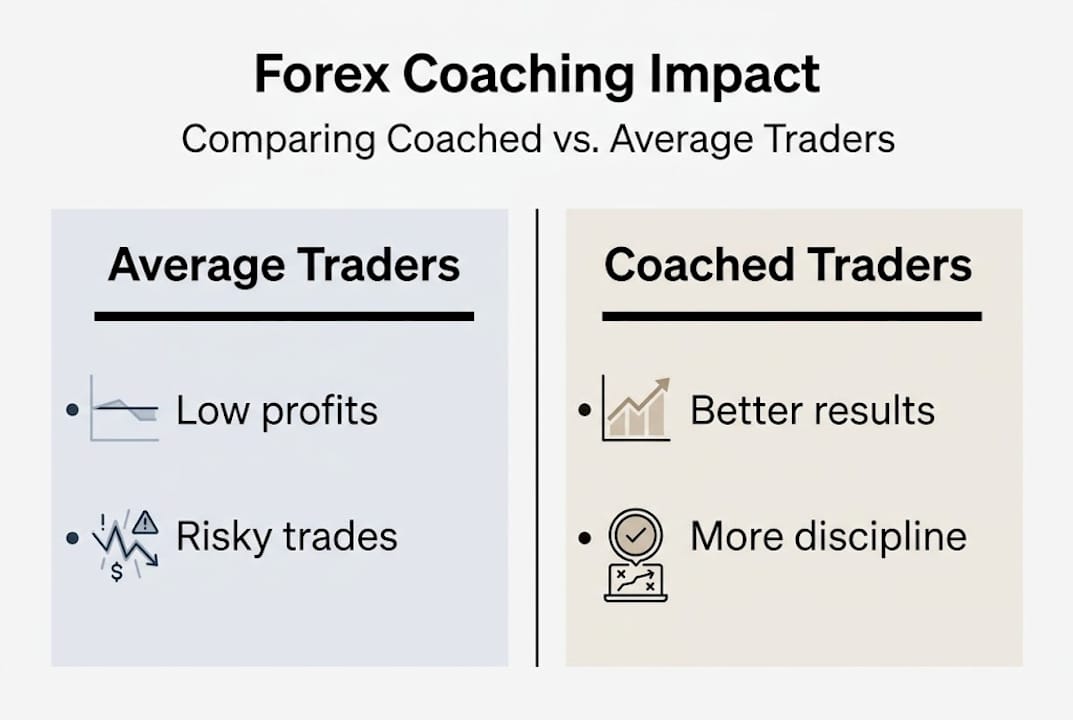
Infographic comparing coached and average forex traders
Broker disclosure data — required by regulators in major jurisdictions — consistently shows that a large majority of retail CFD trading accounts lose money over time. Long-term profitable trading is achieved by a small minority of retail participants. Coaching programs that publish performance data present figures based on specific risk settings and time frames — those figures apply only under the disclosed conditions and do not represent typical outcomes.
Past performance does not guarantee future results. Forex trading carries significant risk of loss. Published program performance figures reflect disclosed assumptions, not individual trader outcomes.
Factors that correlate with higher coaching success include:
- Consistent practice between sessions: Traders who journal and review trades daily improve faster
- Openness to feedback: Defensive traders stall; coachable traders accelerate
- Clear goal-setting: Specific targets (e.g., reduce drawdown by 2%) outperform vague intentions
- Time horizon: Expecting results in weeks leads to disappointment; 3 to 6 months is realistic
- Tool alignment: Using platforms and execution tools that match your coached strategy
For traders managing multiple accounts, the benefits of account management multiply when coaching improves the underlying strategy being replicated. A better master strategy means better outcomes across every account it touches.
Is forex coaching worth it? Limitations, risks, and what to watch for
Coaching can shift your trajectory. But it’s not a guarantee, and the market doesn’t care how much you paid for your program.
The most important thing to internalize before investing in coaching is this: no coach can remove market risk. Volatility, unexpected news events, and liquidity gaps will always be part of the equation. What coaching can do is reduce the self-inflicted losses that come from poor discipline and inconsistent execution.
High program costs and variable quality are real concerns. Some programs charge premium prices for generic content that’s freely available online. Others deliver genuine transformation. The difference often comes down to how much personalized feedback and accountability is built into the structure.
Red flags to avoid when evaluating a forex coach:
- Guaranteed profit claims: Any coach promising specific returns is either misleading you or violating regulations
- Secrecy about strategy logic: A good coach explains the why, not just the what
- No verifiable track record: Testimonials without trade data are marketing, not evidence
- Pressure to buy immediately: Urgency tactics are a classic sign of low-value programs
- No post-coaching support: A program that ends abruptly after payment leaves you without a safety net
Signs of a legitimate, high-value program include transparent student outcomes, a clear curriculum structure, and a coach who actively pushes you to develop independent judgment rather than dependence on their calls.
Pro Tip: Ask any prospective coach for a third-party verified performance record and at least two references from past students you can contact directly. If they hesitate, that tells you everything.
For traders using hedging strategies across multiple accounts, coaching that specifically addresses risk layering and position correlation is worth the premium. Generic coaching won’t address the complexity of multi-account execution.
Why most traders misuse coaching (and what actually works)
Here’s the uncomfortable truth we’ve seen repeatedly: most traders who invest in coaching treat it like a signal service. They want the coach to tell them what to trade, when to enter, and when to exit. Then they follow those calls without building any understanding of why.
That approach produces short-term results and long-term dependency. The moment the coach is unavailable or the market regime shifts, those traders are back to square one.
Real coaching value comes from building decision-making frameworks, not borrowing someone else’s. The traders who get the most out of coaching are the ones who use sessions to stress-test their own thinking, not to outsource it. They ask “why does this setup work?” not “what should I trade today?”
Discipline and structured review are the lasting outputs of effective coaching. Applying advanced forex techniques only matters if you’ve internalized the logic behind them. Ownership of your process is what separates traders who improve from those who plateau.
Where to go next: Smart tools to support your coached trading
Coaching sharpens your strategy. The next step is making sure your execution infrastructure can keep up with your improved decision-making.
](https://csuxjmfbwmkxiegfpljm.supabase.co/storage/v1/object/public/blog-images/organization-20479/1773294400737_mt4copier.jpg)
Local Trade Copier is built for exactly this scenario. When your coaching has refined a master strategy, you need a tool that replicates it instantly across all your MT4, MT5, or DXTrade accounts without manual re-entry or cloud routing delays. With execution in 1 second or faster under normal market conditions and precise SL/TP synchronization across every account, your coached discipline translates directly into clean, consistent execution. Setup is straightforward with a clear installation process, and the 7-day free trial lets you test the full system before committing. Over 3,000 traders have already made it their execution backbone.
Frequently asked questions
How much does forex coaching typically cost?
Coaching programs range from a few hundred dollars to over $2,500 for premium mentorship, depending on the level of access and the coach’s track record. Group programs are more affordable but offer less personalization.
Can forex coaching guarantee trading success?
No. Even the most structured coaching cannot guarantee profits because market risk is always present. Coaching improves your process, not your luck.
How quickly can coaching improve my forex trading?
Some traders notice reduced impulsive mistakes within weeks, but lasting consistency typically requires three to six months of structured feedback and deliberate practice.
What should I look for in a quality forex coach?
Prioritize coaches with transparent, verifiable student results, a clear mentorship structure, and ongoing support that extends beyond just trade call delivery.
Recommended
- Advanced forex trading: techniques for risk and speed
- 5 Secret Ways to Increase Your Forex Profits on MT4 and MT5
- Fail 2 Gain™: Profit From Losing Forex Robots & Traders
- Forex Trading For Beginners: 3 Profitable Strategies For 2023
