

Pip value varies because pip size, contract or lot size, and the quote to account currency conversion determine the cash amount a single pip represents. Before sizing any trade, check three things: the pip convention for that instrument (JPY pairs use a different decimal than most pairs), your lot size, and whether the quote currency matches your account currency. When any of these shift, the dollar value of a pip shifts with them, so a calculator or your broker’s contract specifications should settle any doubt.
TL;DR:
- Most currency pairs use a 0.0001 pip, while yen pairs use 0.01; some CFDs follow separate tick conventions, and pipettes add decimal precision.
- Multiply the pip increment by contract units and lot volume, then convert the result at the current exchange rate when account and quote currencies differ.
- At 0.1 lot in a US dollar account, EUR/USD yields $1 per pip; USD/JPY yields about $6.67 at 150.00.
- Before trading, verify the broker’s listed pip convention and contract size; its specification sheet takes priority over a generic calculator if values disagree.
- When copying trades, scale lots to each account’s balance and currency to preserve proportional risk; use identical lots only for similarly sized accounts in the same currency.
Pip fundamentals: pips, pipettes, and lot sizes
A pip is the standard unit of price movement in forex, typically the fourth decimal place for most currency pairs and the second decimal place for pairs quoted in Japanese yen, according to Babypips’ pip calculator guide. A pipette, or fractional pip, adds one more decimal of precision, letting brokers quote tighter spreads.
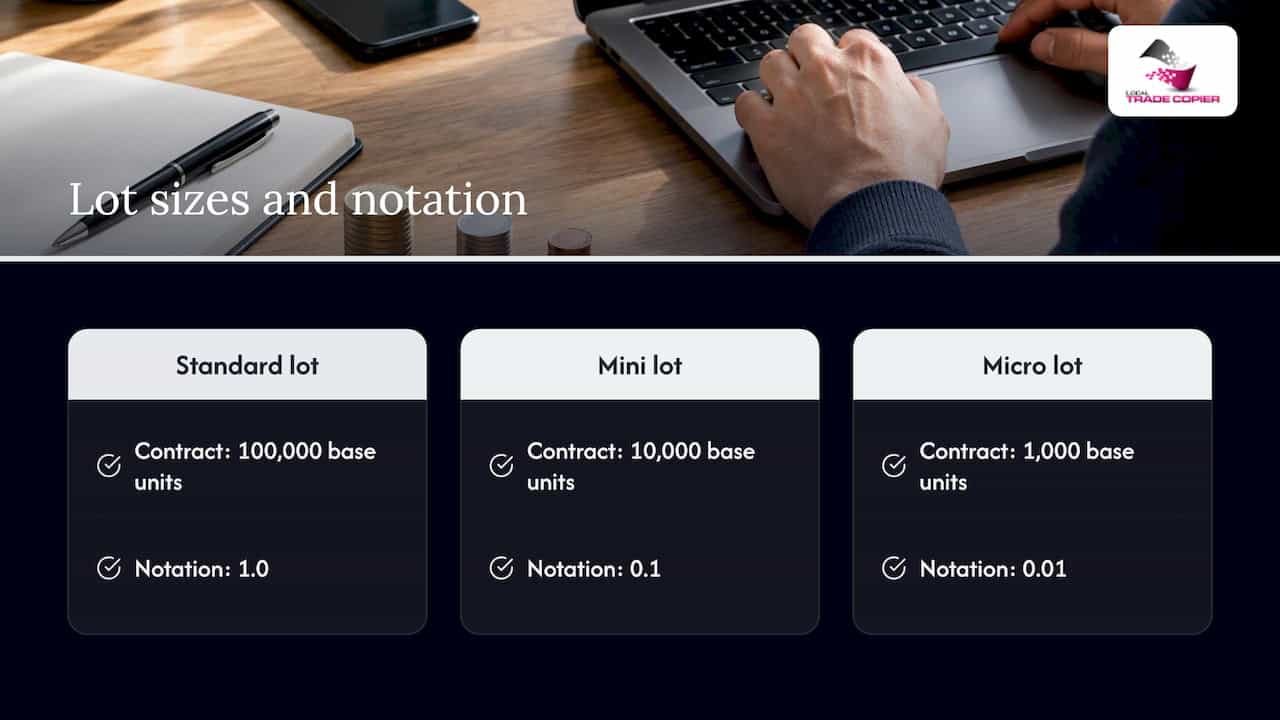
Lot size sets the contract size behind each trade. A standard lot equals 100,000 units of the base currency, a mini lot equals 10,000 units, and a micro lot equals 1,000 units, with lot notation typically written as 1.0, 0.1, and 0.01. Getting pip value right starts with matching the correct pip definition to the correct contract size. Mixing up a 0.0001 pip with a JPY pair’s 0.01 convention, or entering lot size in the wrong unit, is the most common source of miscalculated risk.
Why pip values differ: the drivers you must check
Four factors drive the differences you see between instruments and accounts.
- Lot or contract size: a bigger position multiplies pip value directly, so 1.0 lot carries ten times the pip value of 0.1 lot.
- Instrument convention: JPY pairs use 0.01 as a pip while most other pairs use 0.0001, and some CFDs outside forex follow their own tick conventions entirely.
- Currency conversion: when the quote currency differs from your account currency, pip value must be converted using the current exchange rate before it means anything in your own terms.
- Broker specifications: contract sizes, spreads, and fee structures vary by broker and pricing model, so the confirmation ticket is the final word.
Retail forex brokers are required to disclose transaction costs such as commissions or spread markup, and the pricing model behind that disclosure, STP versus dealing desk, changes how those costs sit inside the quote you trade on, according to NFA’s proposed cost disclosure amendments. Checking your broker’s contract specification sheet before you trade is the simplest way to confirm which of these conventions apply to your account.
How to calculate pip value step by step
Pip value in the quote currency follows one formula, confirmed by AskTraders’ pip value calculator guide: pip size multiplied by contract size multiplied by lot size. From there, a short sequence gets you to a number you can actually use for risk decisions.
- Identify the pip size for your instrument (0.0001 for most pairs, 0.01 for JPY pairs).
- Multiply pip size by the contract size (100,000 for a standard lot) and by your lot size.
- If the quote currency differs from your account currency, convert the result using the current exchange rate, dividing when your account currency is the base of that rate and multiplying when it is the quote.
- Multiply the converted pip value by your intended pip distance (stop loss or target) to get total cash risk.
- Double check JPY pairs and any pipette-quoted instrument separately, since a misplaced decimal there changes the answer tenfold.
Pro Tip: Run the same trade through a pip calculator and your broker’s contract specs before entering a position larger than your usual size, since small rounding differences compound fast on bigger lots.
Using pip calculators and reading broker contract specs
A pip calculator needs four inputs: your account currency, the currency pair, your position size, and the current exchange rate, as described in Babypips’ calculator documentation. The output converts the raw quote-currency pip value into your own account currency so you can compare risk across instruments on equal footing.
Broker contract specifications sometimes deviate from the textbook 100,000-unit standard lot, and some instruments carry extra decimal precision through pipette quoting. Before trusting a number, run these checks:
- Confirm the pip definition listed for that specific instrument, including whether pipettes apply.
- Confirm the contract size shown on the broker’s specification sheet, not an assumed default.
- Re-enter your account currency correctly, since a wrong currency silently skews every downstream number.
- If the calculator and the broker’s own quoted pip value disagree, trust the contract specification sheet over a generic calculator default.
Worked examples: EUR/USD, USD/JPY, and a cross pair
These are illustrative calculations using the formula above, not live market data.
- EUR/USD, 0.1 lot: pip size 0.0001 multiplied by contract size 100,000 multiplied by 0.1 lot equals $1.00 per pip, already in US dollars if that is your account currency.
- USD/JPY, 0.1 lot: pip size 0.01 multiplied by 100,000 multiplied by 0.1 lot equals 1,000 yen per pip. If USD/JPY trades at say 150.00, dividing 1,000 yen by 150.00 converts that to approximately $6.67 per pip in a US dollar account.
- A cross pair where neither currency is your account currency, such as EUR/GBP held in a US dollar account, needs a second step: calculate the pip value in the quote currency (GBP) first, then convert GBP to USD using the current GBP/USD rate.
The same one-pip move can be worth roughly six times more or less depending on the instrument and the lot size behind it, exactly why pip value calculators exist rather than relying on a flat per-pip assumption. Past results do not guarantee future performance, and these worked figures are for illustration only, not a forecast of any specific trade outcome.
Copying trades across accounts with different currencies
When you copy trades from a master account to client accounts, pip value mismatches appear the moment the accounts use different base currencies or different balances, since the same lot size produces a different cash value in each. Preserving the intended cash risk across accounts means scaling lots deliberately rather than copying them one-to-one.
- Same-lot copying keeps identical lot sizes across accounts, which suits accounts of similar size and currency.
- Balance-percent scaling adjusts lot size to each account’s balance, which keeps cash risk proportionally consistent even when account currencies or sizes diverge.
Our own guide on copying between different account currencies walks through the configuration steps for traders managing this exact scenario.
What experienced traders check before every trade
Experienced traders compute cash risk in their own account currency before entering a trade, not just the pip distance to a stop loss. They re-check pip value whenever they switch instruments or trade from an account in a different currency, since the same setup rarely produces the same dollar exposure twice. A calculator and a glance at the broker’s contract specification sheet belong in that pre-trade routine every time, not just when something looks unusual.
A practical way to keep pip-value math consistent across accounts
Copying the same trade to multiple accounts only preserves your intended risk when lot sizes are scaled to match each account’s currency and balance, and doing that by hand across several terminals invites the exact rounding errors this guide walks through. Our Local Trade Copier runs locally on your own machine or VPS and replicates trades from a master account to multiple MT4 and MT5 client accounts with automatic lot scaling per account balance, so the cash risk you intend on the master account carries through consistently. It is trade replication software only: it copies existing trades and applies the lot-sizing rules you configure, without any market logic or strategy layer.

For prop firm traders tracking funded-account rules alongside pip-value math, Profirms’ drawdown tracker is a useful companion for monitoring end-of-day drawdown limits across accounts. If you manage trades across multiple MT4 or MT5 accounts and want lot scaling handled automatically, start with a 7-day free trial or see the installation guide to check compatibility with your setup.
This article is general information, not a substitute for advice from a qualified financial advisor. Consult a qualified financial professional about your own circumstances before acting on anything here.
FAQ
How much is 1 pip in 0.01 lot size?
For a standard pair like EUR/USD, 0.01 lot (1,000 units) produces a pip value of pip size (0.0001) multiplied by contract size (100,000) multiplied by 0.01 lot, which equals $0.10 per pip when your account is denominated in US dollars, per the pip value formula. For JPY pairs, the same lot size uses the 0.01 pip convention instead, changing the result.
Is 100 pips 1%?
No fixed percentage applies, since 100 pips represents a different percentage of price movement depending on the instrument’s exchange rate and your position size relative to account equity. Calculate the actual price move and compare it to your account balance directly rather than assuming a universal ratio.
How much is 1 pip worth in US dollars?
It depends on the pair, lot size, and whether a currency conversion is needed, following pip size multiplied by contract size multiplied by lot size as explained in Babypips’ calculator guide. For EUR/USD at a standard 1.0 lot, 1 pip equals one hundred times the pip value for smaller lots in a US dollar account; smaller lots and different pairs produce different values.
How much is 100 pips worth?
Multiply your per-pip value by 100 to get the total cash value of a 100-pip move. For EUR/USD at 0.1 lot, where 1 pip equals one dollar, a 100-pip move equals a hundred times that pip value, though this changes with lot size, instrument, and account currency as shown in the worked examples above.
Sources
- Asktraders
- Disclosure of Retail Forex Costs to Customers – Proposed Amendments to NFA Compliance Rule 2-36; Requirements for Forex Transactions and NFA Compliance Rule 2-43: Forex Orders
- Babypips
