

Short verdict: U.S.-regulated MT4 retail accounts cannot hold simultaneous buy and sell positions on the same currency pair because of NFA FIFO and offsetting rules. MT4 itself still supports hedging as a platform, but U.S. brokers enforce first-in-first-out order handling on your account, which blocks the practice. Traders who need similar protection typically turn to options, futures, correlated pairs, or compliant trade copying across separate accounts.
TL;DR:
- U.S.-regulated retail forex accounts are required by NFA rules to offset positions in the same currency pair on a first-in, first-out basis, preventing overall simultaneous buy and sell tickets.
- MT4’s hedging architecture remains, but brokers enforce FIFO offsetting at the server level, often causing opposing orders to close existing positions instead of opening new hedges.
- Alternatives for managing directional risk include options, futures, correlated pairs, and multi-account setups, each with specific costs and limitations.
- Expert Advisors designed for hedging break on U.S. accounts because of FIFO rules, which can cause order rejections or unexpected position closures during automated trading.
- Proper testing on demo accounts and thorough support confirmation are crucial before deploying live strategies or copy setups that rely on hedging or opposing orders.
What NFA Rule 2-43 Actually Requires
The restriction on same-pair hedging is not an MT4 feature or a broker preference. It comes from a specific regulatory requirement written into the rulebook of the National Futures Association, the self-regulatory body that oversees U.S. retail forex brokers under the authority of the Commodity Futures Trading Commission. The CFTC sets the broader federal framework for derivatives and forex regulation, and the NFA writes and enforces the detailed conduct rules for its member firms.
The specific text lives in NFA Compliance Rule 2-43, which requires Forex Dealer Members to offset customer positions in a currency pair on a first-in, first-out basis and prohibits carrying offsetting positions in the same account. In plain language: if you already hold a long position on EUR/USD and you place a sell order on the same pair in the same account, your broker cannot let both positions sit open side by side. The sell order closes out the existing long, starting with the oldest lot, instead of opening a separate short position next to it.
A few points define who this applies to and why it exists:
- The rule binds Forex Dealer Members, meaning U.S.-regulated retail forex brokers registered with the NFA, not brokers based in other jurisdictions serving other markets.
- It applies to retail customer accounts opened with those U.S. firms, regardless of which trading platform sits on top, MT4, MT5, or a proprietary system.
- FIFO offsetting is meant to create predictable order handling and consistent recordkeeping across firms, part of a broader set of risk-management and reporting obligations retail forex dealers carry.
- The rule does not ban hedging as a concept, futures and options hedging remain fully available, it bans a specific mechanic: two opposing tickets on the identical pair inside one account.
It is worth being precise here because a lot of trading forums blur the language. This is not a CFTC statute banning hedging outright, it is an NFA member conduct rule about how offsetting orders are processed. The distinction matters if you are trying to figure out what is actually prohibited versus what is simply unavailable through a particular broker’s account structure.
MT4’s Hedging Design vs. What Your Broker Actually Lets You Do
This is where most of the confusion starts, and it is worth untangling carefully. MetaTrader 4 was built with a hedging-capable order model: every trade opens as its own ticket, and the platform has no problem showing a long ticket and a short ticket on the same pair sitting open at the same time. That architecture has not changed. The confusion comes from what happens once that order reaches a U.S. broker’s servers.
According to an industry explanation from OANDA, the hedging ban is enforced at the broker level, not inside the platform itself. MT4’s hedging architecture still exists, but a U.S.-regulated Forex Dealer Member configures its execution servers or back-office systems to apply FIFO logic before an offsetting order is allowed to sit open. The practical effect is that even though MT4 supports independent tickets, the broker intercepts an opposite-direction order and treats it as a close instruction against your oldest open lot rather than a new hedge position.
A few things this produces in practice:
- Forced offsets: an attempt to sell EUR/USD while already long EUR/USD closes existing volume, starting with the oldest lot, instead of opening a new short ticket.
- Order rejections: some brokers reject the order outright rather than silently converting it, particularly with EAs sending rapid opposing orders.
- Stop loss and take profit confusion: because the “hedge” order actually reduces or closes the original position, any SL/TP tied to that original ticket may trigger, cancel, or behave unexpectedly.
- Ticket ID mismatches: EAs that track specific ticket numbers to manage a hedge lose the reference once the platform’s FIFO logic merges or closes positions differently than the code expects.
The same OANDA analysis notes that this is a jurisdictional decision, not a limitation baked into the software: traders in other markets, including parts of Europe and various offshore jurisdictions, may have hedging available on the same platform depending on local rules and the broker’s own policy. So if you have read about hedging working fine on MT4 somewhere else, that is accurate for that jurisdiction. It just does not apply once your account sits with a U.S.-regulated firm.
Pro Tip: Before you assume an EA “supports hedging,” check whether it was built and tested on a hedging-enabled account outside the United States. Behavior that looks stable in backtests can break the moment FIFO logic starts converting your opposing orders.
Legal Ways to Manage Directional Risk Without Same-Pair Hedging
Losing the ability to hold opposing tickets on one pair does not mean you lose the ability to manage risk. It means the tools shift.
- Currency options. Buying a put or call option lets you offset directional exposure without touching your spot position, since the option is a separate instrument with its own contract terms. The tradeoff is the premium you pay upfront, which is a real cost regardless of whether the market moves against you.
- Currency futures. Exchange-traded futures on major pairs give you a way to offset spot exposure through a different market structure entirely, subject to margin requirements and contract specifications set by the exchange rather than your forex broker.
- Correlated-pair hedging. Instead of shorting EUR/USD directly against a long EUR/USD position, you take an offsetting position in a pair that historically moves in a related pattern, such as taking a short EUR/GBP position to partially offset EUR exposure. This is an indirect hedge, and correlations shift, so it is never a precise substitute.
- Position sizing and scaling out. Reducing size as a trade moves against you, or scaling in gradually rather than committing full size at entry, addresses the same underlying goal, limiting downside, without needing an opposing ticket at all.
- Multi-account structures with compliant trade copying. Some traders run separate accounts, sometimes with different brokers, and use copying software to mirror or adjust positions across them in a way that respects each account’s own FIFO rules individually rather than trying to hold opposing tickets inside one account.
Every one of these carries its own cost or tradeoff, and none of them guarantees a particular result. Options carry premium costs that erode returns if the hedge is not needed. Correlated pairs introduce basis risk when the correlation breaks down at the worst possible moment. Splitting exposure across multiple accounts adds operational complexity and, if not configured correctly, can trigger the very red flags prop firms and brokers watch for. Past results do not guarantee future performance, and no combination of these techniques removes market risk, it only reshapes where that risk sits. Our internal guide on hedging strategies and risk mitigation walks through these tradeoffs in more detail for traders weighing which approach fits their setup. For traders who want a mechanical way to scale exposure down rather than open a full opposing position, a partial close approach on MT5 is a practical technique worth understanding alongside these options.
Why Expert Advisors Built for Hedging Break on U.S. Accounts
A large share of the EAs sold or shared in trading communities were coded with a hedging-style assumption baked in: open a position, and if price moves against it, open an opposite ticket as a hedge or a grid layer, then manage both independently. That logic depends on the platform letting two opposing tickets on the same pair coexist. On a U.S.-regulated FIFO account, that assumption fails at the first opposing order.
The failure is not random. It happens because the EA is written around ticket-level thinking, track this specific order number, adjust that specific order number, while the broker’s execution layer is applying FIFO offsetting at the position level. When those two models collide, the EA either throws an order-rejected error, or it succeeds in placing the order but the broker’s system immediately nets it against the existing position, leaving the EA’s internal tracking pointing at a ticket that no longer represents what the code thinks it represents.
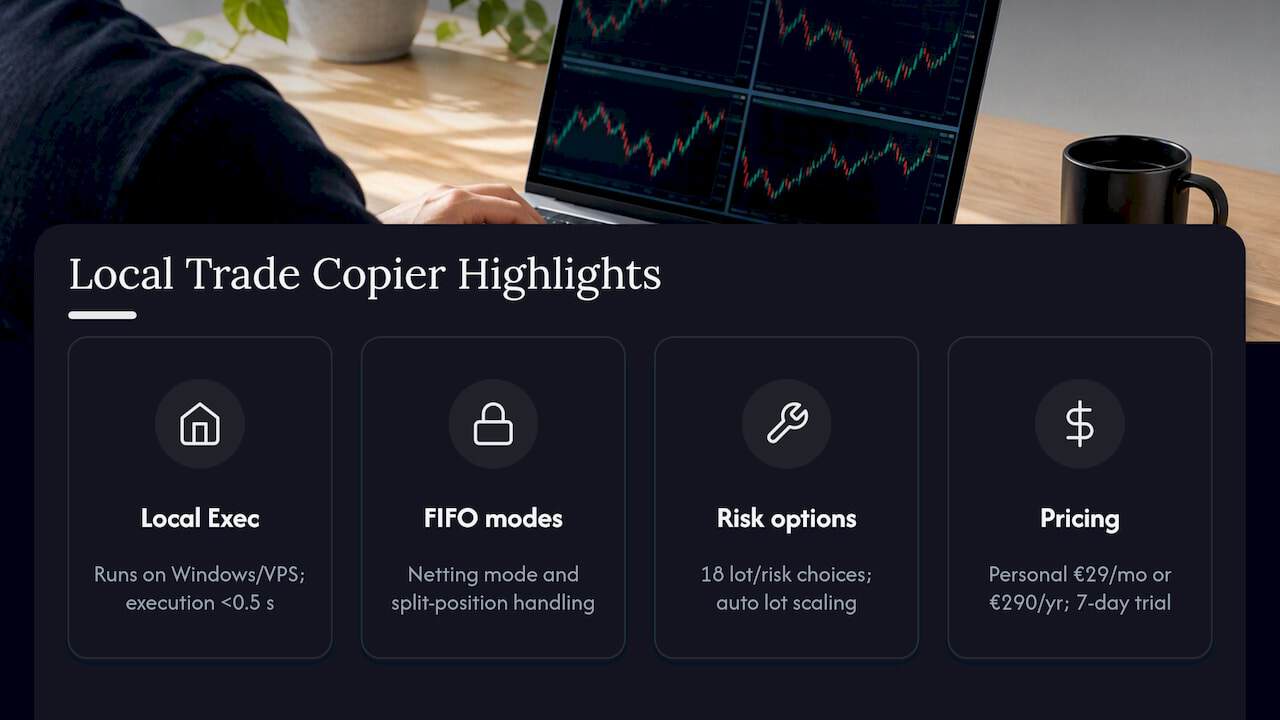
For anyone running a copy setup rather than a single EA, the same conflict shows up between netting-mode and hedging-mode configurations. A master account running hedging-style logic will send opposing signals that a FIFO-compliant client account cannot execute the same way. This is precisely the gap that netting-mode configurations in trade-copying software are meant to close, translating a hedging-style signal into something a FIFO account can actually execute without breaking. Local Trade Copier documents a netting mode built specifically for MT4 FIFO accounts, along with split-position handling and configurable lot scaling per client account, features aimed at exactly this mismatch rather than at generating any particular trading outcome. Our netting-mode setup guide covers configuration in detail, and the limitations and expected behaviors page is worth reading before assuming any copy setup will behave identically across a hedging account and a FIFO account.
A few practical habits reduce surprises:
- Test any EA or copy configuration on a demo account first, and watch how it behaves the moment an opposing order would normally fire.
- Log order IDs and timestamps so you can see exactly when and how the broker’s FIFO logic altered your intended sequence.
- Where the strategy truly needs independent-looking exposure, consider split trades or a reversed-copying approach instead of forcing a same-account hedge.
Pro Tip: Run a small-lot test cycle on demo before committing a live account: open a position, then trigger the opposite-direction signal your EA or copier would normally send, and watch exactly what the platform does with the ticket. That five-minute test reveals more than reading documentation.
How Prop Firms Handle Hedging and Cross-Account Rules
Prop firm rules on hedging tend to be stricter than what your broker’s FIFO settings alone would require, and that distinction trips people up. A firm can run its evaluation accounts on a platform that technically allows some flexibility, and still prohibit hedging-style behavior entirely through its own trading agreement.
The pattern shows up in a few common forms:
- No opposing trades across accounts. Opening a long on one funded account and a short on another account, whether both are with the same firm or split across firms, to try to guarantee a passing result on at least one evaluation is treated as gaming the system rather than trading.
- No cross-account wash hedging. Using multiple accounts to offset the same market exposure so that a loss on one side is masked by a gain on the other, without any independent trading rationale, is generally against firm policy even where the letter of a FIFO rule would not catch it.
- Consequences are typically account-level, not just position-level. Firms that detect this behavior tend to fail the evaluation, close the funded account, or ban the trader from future evaluations, rather than simply reversing the flagged trades.
A short compliance checklist for prop participants:
- Read the firm’s specific hedging and multi-account language before assuming your broker’s rules are the only rules in play.
- Keep any legitimate multi-account activity, such as running a personal account alongside a funded one, clearly documented with a rationale that is not simply offsetting the same trade.
- Ask the firm directly, in writing, before running any copy or scaling setup across more than one of its accounts.
Our best practices guide for multi-account copying with prop firms covers the setup side of this in more depth for traders managing several funded accounts at once.
A Pre-Launch Checklist Before You Rely on Any Hedging Workaround
Before committing real capital to any workaround, whether that is an EA, a copy setup, or a multi-account structure, a short verification pass saves a lot of grief later.
- Confirm your account type in writing. Ask your broker directly whether your account is configured as netting or hedging, and get the FIFO disclosure language from your account agreement rather than assuming based on the platform name.
- Test the exact sequence in demo first. Open a position, then send the opposite-direction order your strategy would normally place, and watch whether it opens a new ticket, partially closes the existing one, or gets rejected outright.
- Check stop loss and take profit behavior specifically. Confirm what happens to any SL/TP attached to the original ticket once an offsetting order hits, since this is where unexpected losses tend to surface.
- Get written confirmation from support. A support ticket or email confirming how your specific account handles offsetting orders is worth far more than a forum post, and it gives you a record if behavior later changes.
- Test your copier or EA on a VPS under realistic timing. Latency and execution timing can change how FIFO logic interacts with rapid opposing signals, so test under the same conditions you plan to run live. Our installation guide walks through setting this up on a Windows machine or VPS.
- If you are weighing an offshore broker to regain hedging, check its regulatory status and test withdrawals early, ideally with a small amount, before relying on the account for anything meaningful. Offshore hedging access can carry real legal and security tradeoffs for a U.S. resident, and a partner analysis on copy trading legality in the U.S. is a useful starting point for understanding where those lines sit.
Pro Tip: Save every support confirmation and demo test log in one folder. If your broker or prop firm ever disputes how an order was handled, having a dated record of exactly what you tested and what support told you is the difference between a quick resolution and a drawn-out account dispute.
Why This Rule Frustrates More Traders Than It Should
Most of the frustration around the U.S. hedging restriction comes from treating it as a platform limitation instead of what it actually is, a jurisdictional compliance decision applied at the broker level. That distinction changes how you should respond to it. Fighting the platform, hunting for an MT4 “hedging unlock,” or assuming a plugin will bypass NFA-mandated FIFO logic is a waste of time, because the restriction lives in your broker’s regulatory obligations, not in a setting you can toggle.
The more useful response is treating FIFO as a fixed constraint and redesigning your risk management around it, the same way you would design around any other structural rule of the market you trade in. Traders who adapt fastest are usually the ones who stop asking “how do I hedge on this account” and start asking “what does this specific FIFO account allow me to build instead.” That reframe leads toward options, correlated exposure, disciplined position sizing, or a properly configured multi-account structure, rather than toward increasingly creative attempts to trick a single account into behaving like two.
— Rimantas
Where Local Trade Copier Fits for FIFO-Constrained Traders
If you manage more than one account, personal, funded, or both, the FIFO constraint does not have to mean managing every account by hand. Local Trade Copier is Expert Advisor-based software that replicates trades from a master account to one or more client accounts across MT4, MT5, and DXTrade, running entirely on your own Windows machine or VPS rather than through a cloud service.

That local-execution design matters specifically in the FIFO context. Because everything runs on-machine, execution happens in well under half a second, and the software includes a netting mode built for MT4 FIFO accounts alongside split-position handling and 18 lot-size and risk-management options, including automatic lot scaling based on each client account’s balance. None of this changes how the market behaves or promises any particular trading result, it is trade replication software: it copies existing trades and applies the sizing and mode you configure, with no market logic or strategy layer of its own. Past results do not guarantee future performance, and nothing here should be read as a claim about returns.
For a trader running a personal account and a prop-firm account side by side, or an account manager copying to several client accounts, that combination of local execution and FIFO-aware modes is the practical value: less manual re-entry, one IP address instead of cloud routing that some prop firms flag, and configuration options built around the account-type differences this article covers.
Plans start with the PERSONAL Plan at 29 € per month or 290 € per year, scaling up to the MANAGER Plan and VIP Plan for traders managing more accounts, all backed by a 7-day free trial. If you want to see the netting-mode behavior before committing, the demo video shows the setup in action, and the pricing page has the full plan breakdown.
This article is general information, not a substitute for advice from a qualified financial advisor. Consult a qualified financial professional about your own circumstances before acting on anything here.
Sources
- Rules | NFA — RULE 2-43. FOREX ORDERS
- NFA FIFO rule challenges expert advisors — OANDA
- Commodity Futures Trading Commission (CFTC)
FAQ
Can I use MT4 in the USA?
Yes, MT4 is fully available to U.S. traders through NFA-regulated brokers, and the platform itself works the same way it does anywhere else. What changes is account behavior, not software availability: your U.S. broker applies FIFO offsetting rules at the account level, which limits certain order combinations like same-pair hedging.
Is hedging illegal in forex?
Hedging itself is not illegal, and options and futures-based hedging remain fully available to U.S. traders. What U.S.-regulated retail forex brokers cannot allow, under NFA Compliance Rule 2-43, is carrying two opposing spot positions on the identical currency pair in the same retail account.
Does MetaTrader 5 have the same hedging restriction as MT4?
Both MT4 and MT5 support hedging-capable account types as platforms, so the restriction is not specific to one version. On accounts opened with a U.S.-regulated broker, the same NFA FIFO offsetting requirement applies regardless of whether you trade on MT4 or MT5.
Will a trade copier let me get around the hedging ban?
No software can override an NFA-mandated FIFO rule, since the restriction is enforced by your broker to meet its regulatory obligations. What a copier configured with a netting mode and split-position handling can do is help you manage multiple compliant accounts without the FIFO logic breaking your copy setup, which is different from bypassing the rule itself.
What happens if my EA sends an opposing order on a FIFO account?
Depending on the broker’s configuration, the order either closes existing volume on a first-in, first-out basis or gets rejected outright rather than opening as a separate hedge position. This is a documented source of EA malfunctions on U.S. accounts, so testing any hedging-style EA on a demo account first is worth the time before running it live.
Recommended
- The Definitive Guide to Forex Trade Copying – Chapter 9
- How to use Trade Copier in Netting mode on MT4 FIFO accounts
- US Traders: Avoid CFTC/NFA Registration With Local MT4/MT5 Copy Trading
- MT4 Trade Copier limitations with Netting on FIFO accounts
